
No products in the cart.
Hermaphrodite Cannabis Plants: Causes, Prevention and Solutions
Finding male flowers, pollen sacs or small yellow “bananas” on what should be a female cannabis plant can be alarming. The immediate reaction is often to blame the seeds or genetics. This detailed guide will help you identify hermaphroditic Cannabis plants early and to diagnose the causes so you can fix it before it becomes a nightmare for your grow.
What is a hermaphrodite Cannabis Plant?
As this article covers a more advanced topic of Hermaphrodite Cannabis Plants, for newer growers you can also checkout the following articles for some quick background reading if needed
What actually is Cannabis?
How Cannabis Breeding Works
Cannabis Flowering Genetics
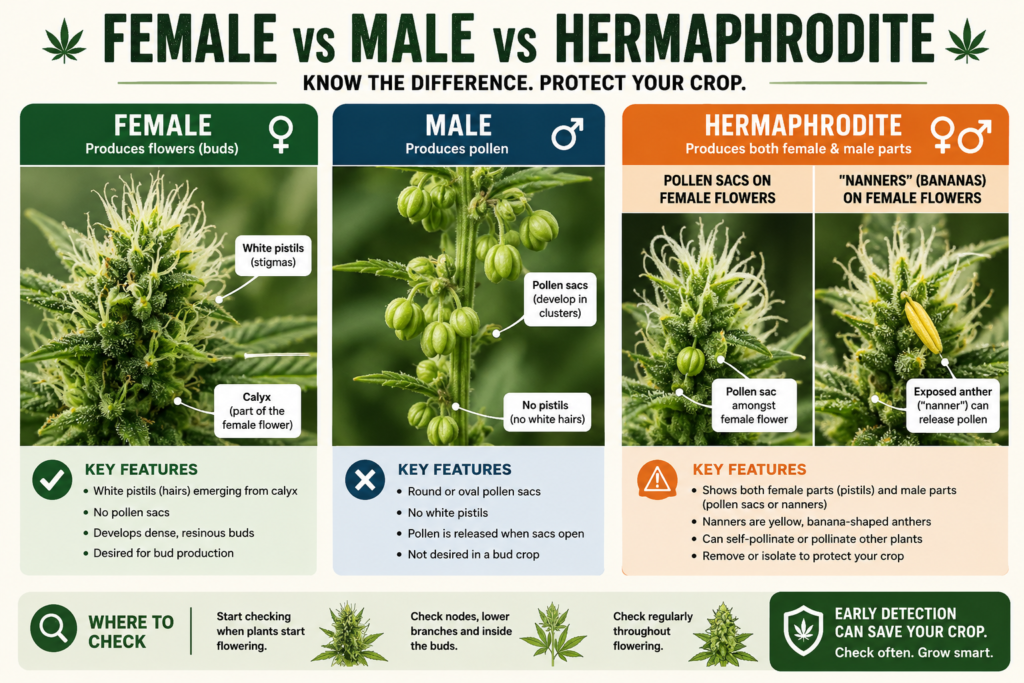
Cannabis plants typically develop as either male or female. Female cannabis plants produce pistillate flowers, while male plants produce pollen-producing staminate flowers.
A hermaphrodite (otherwise known as a “hermie”) — is a plant that develops both female and male reproductive structures. Unless you are trying to produce Cannabis Seeds, growers unilaterally want to produce un-pollinated female flowers, so the presence of a male (pollen) is not something you want to see!
Female pre-flowers produce white pistils. These pistils are one of the easiest early indicators of a female plant.
Male pre-flowers produce pollen sacs which appear as small rounded structures that develop without the white pistils associated with female flowers. As they mature, the sacs can open and release pollen.
Finding genuine pollen sacs developing amongst otherwise female flowers is a strong indication of mixed-sex or hermaphroditic expression.
Importantly, the appearance of male structures on a female plant does not automatically prove that the original seed was genetically defective. Cannabis has considerable sexual plasticity, meaning environmental and physiological conditions can influence how sex is expressed during the plant’s development.
What Causes a Hermie Cannabis Plant?
Hermaphroditism is a big deal for Cannabis Breeders. If a strain or phenotype has a tendency towards hermaphroditism, it does not make it to the next phase of breeding. Reputable breeders actively select against plants that show a tendency towards hermaphroditism, substantially reducing the likelihood of genetic instability in established seed lines.
So while the genetics play a significant role, even the most gender stable strains can easily succumb to hermaphroditism if the growing conditions involve significant enough environmental stress.
Genetics certainly matter — but genetics are only part of the equation.
Most Common Causes
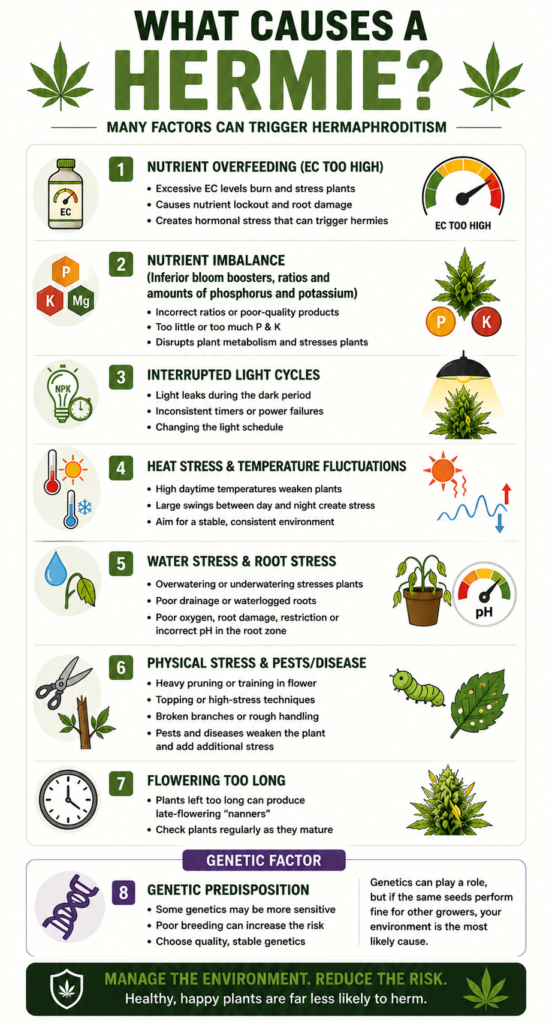
If you’ve purchased Feminized Cannabis Seeds from a reputable seedbank or breeder, with today’s breeding practices, the likelihood that genetics is sole cause of hermies is very low. While there are certain breeds more prone (such as Thai Sativa Varieties) it is more likely that un-addressed environmental factors are playing a significant part. (In priority order);
- Nutrient Over-Feeding. Running an unnecessarily high EC can cause excessive nutrient accumulation in the root zone and increase the risk of nutrient imbalance.
- NPK Imbalance. Are you quickly shifting to a very high PK ratio at flowering? Consider staggering this shift over a couple weeks
- An abrupt light schedule change can stress the plant. Consider staggering the cycle change over a weekly period
- Heat/Cold stress can contribute to overall plant stress causing the plant to become ‘confused’ and ‘run to seed’ kind of like a lettuce plant in the middle of summer
- Over / under watering, poor drainage or waterlogging can be easily mitigated with the correct growing system
- In rare cases, low stress training, and other physical stress training can disrupt the plant’s normal bio-algorithm creating unfavorable conditions.
- If the plant becomes exhausted, late flower ‘nanners’ are quite common.
- Genetic Factors and poor breeding can increase the risk of hermies. Check with your seed supplier if they have examples of particular strains being more susceptible to hermie issues.
Nutrient Over-Feeding, A Closer look
One of the first things to investigate when a previously healthy cannabis plant begins showing unusual stress during flowering is how heavily it is being fed.
It is easy to assume that more nutrients will produce bigger flowers, particularly when a plant enters its most demanding stage of development. But plants can only absorb and use nutrients within certain physiological limits. Increasing fertiliser strength beyond what the plant can utilise increases the concentration of dissolved mineral salts around the root zone — measured broadly as Electrical Conductivity (EC) — without necessarily improving growth, flower yield or quality.
Recent controlled cannabis research found that doubling nutrient-solution EC from 2 to 4 mS/cm caused considerably greater nutrient accumulation in the root zone but did not significantly improve flower yield or quality. In other words, a higher EC does not automatically mean a better-fed plant.
The “More PK” During Flowering Debate
Well, it’s not really a debate at this point, everyone knows it’s higher Nitrogen (N) during the vegetative stage shifting towards less Nitrogen and more Phosphorus (P) and Potassium(K) during the flowering stage.
The debate comes in at just how much PK vs N during flowering, and how to do this without causing plant stress. That’s the secret sauce that most growers don’t want you to know.
The balance between nitrogen (N), phosphorus (P) and potassium (K) is the key consideration.
Cannabis growers have traditionally been encouraged to dramatically increase phosphorus and potassium during flowering through high-PK “bloom boosters”. Scientific research paper is increasingly questioning this practice. One controlled flowering study found an optimum phosphorus concentration around 59 mg/L under its particular experimental conditions, while noting that some cannabis fertilisers and feeding practices supply phosphorus at levels exceeding 200 mg/L. Other research comparing 25, 50 and 75 mg/L phosphorus found no significant improvement in flower yield or cannabinoid concentration as phosphorus increased. The plants simply accumulated more phosphorus, while substantially more was lost in the leachate. The lesson isn’t that phosphorus is unimportant — it is essential — but that more phosphorus does not automatically produce more flowers.
Nutrient Ratios Matter as Much as Nutrient Strength
Excessive potassium can create a different problem. Potassium is essential for water regulation, plant metabolism and flower development, but very high K concentrations can alter the uptake and accumulation of other minerals.
In this study on the effects of Potassium (K) on Cannabinoids, Terpenes and plant function, demonstrated that increasing potassium can significantly reduce calcium and magnesium accumulation in plant tissues because these positively charged nutrients interact and compete during uptake. This means a grower can technically have plenty of calcium or magnesium in the nutrient solution while the plant still struggles to acquire the correct balance. Nitrogen form and concentration can also influence the uptake of other nutrients. Rather than viewing N, P and K independently, think of the root zone as an interconnected chemical system: changing one nutrient can influence the availability and uptake of several others.
Bottom Line - Increase PK, but do it carefully
Try not to shock the Plant With a Sudden Major Feeding Change
Basically, rather than switching overnight from a high N | Low PK regime, it’s more preferable in the early stage flowering phase to simply increase PK while keeping N stable. Then, over a period of weeks, reduce the N and keep the PK stable or very slightly increased. Remember more is not always better! The plant can only take in so much nutrient.
A sudden and aggressive nutrient shift is a common cause of plant stress and can often lead to hermaphroditism. The objective during flowering should not be to feed the highest EC the plant can survive; it should be to provide a stable, balanced nutrient supply that the plant can actually use.
FAQ - Hermaphrodite Cannabis Flowers
Cannabis sex expression is influenced by a combination of genetics, hormones, plant development and environmental conditions. Potential stress factors include disrupted light cycles, temperature extremes or fluctuations, water and root stress, nutrient imbalance and other significant disturbances during flowering. Rather than assuming genetics are responsible, growers should examine the entire growing environment and consider what changed before the male flowers appeared.
Nutrient overfeeding can create excessive nutrient concentrations in the root zone and contribute to plant stress, but there is currently insufficient scientific evidence to say that high EC or overfeeding alone directly causes cannabis hermaphroditism. It is better considered one potential stress factor, particularly when combined with heat, watering problems, root stress or other environmental issues.
There is currently no established phosphorus or potassium concentration at which cannabis will become hermaphroditic. However, excessive P and K are not necessarily beneficial during flowering. Cannabis research has found that increasing phosphorus beyond the plant’s requirements does not necessarily increase flower yield, while excessive potassium can interfere with calcium and magnesium accumulation. Maintaining balanced nutrition is therefore preferable to assuming that more PK will produce better flowers.
Disruption of photoperiod has been associated with changes in cannabis sex expression, making a stable light/dark cycle important for photoperiod plants. However, recent research suggests that occasional low-intensity light leakage does not automatically cause male flowers. The duration, intensity and timing of the light disturbance, plant development and genetics may all influence the response. A reliable timer and consistent uninterrupted dark period remain sensible growing practices.
Temperature stress and fluctuations have been associated with changes in plant reproductive development and are considered potential contributors to cannabis sex instability. This can be particularly relevant in Australian conditions where grow tents, sheds and other enclosed spaces can become considerably hotter than the outside air. Temperature should be measured around the plant canopy rather than relying solely on the local weather forecast.
Not necessarily. Genetics can influence sex expression and some plants may be more susceptible than others, but finding a hermaphrodite does not by itself prove that the seeds have defective genetics. If plants from the same seed batch are growing normally elsewhere, differences in local growing conditions should be carefully investigated before concluding that the seeds are responsible.
Yes. Feminized cannabis seeds are produced to develop as genetically female plants, but genetically female cannabis can still produce male reproductive structures under certain hormonal, physiological or environmental conditions. In fact, this sexual plasticity is deliberately utilised by breeders when producing feminized seeds.
Pollen sacs are rounded male flower structures that develop and eventually open to release pollen. “Nanners” or “bananas” are exposed anthers that can appear as small yellow or pale banana-shaped structures emerging directly from female flowers. Nanners can be particularly difficult to detect because they may appear from inside an otherwise normal-looking flower.
It depends on the extent and timing of the male flower development. One isolated anther appearing very late in flowering is different from a plant repeatedly producing clusters of pollen sacs early in flower. If numerous male structures continue to develop, the plant can pose a pollination risk to nearby females and isolation or removal may be appropriate.
Yes. If male reproductive structures produce viable pollen, that pollen can fertilise receptive female flowers on the same plant or nearby plants. Pollination causes female flowers to begin producing seeds, which is why early identification of pollen sacs and exposed anthers is important when the objective is to produce unpollinated flowers.

About the author:
As a passionate gardener and advocate for self sufficiency and food security, CG aims for moderation and reverence of Cannabis as an ancient and powerful natural medicine. As the taboo steadily lifts worldwide, we’re here to help responsible, law abiding adults to experience the joy and wonder of nurturing a tiny seed from humble germination to bountiful harvest.